
The Real Failure Isn’t the One You’re Afraid Of
A while back, I was mentoring someone who wanted to move into teaching. He wasn’t sure he had it in him — that quiet, familiar doubt that shows up before almost anyone tries something new.
We talked through an approach. He was excited to try it.
Then he tried it. And it didn’t go well.
“I failed,” he told me, a little deflated.
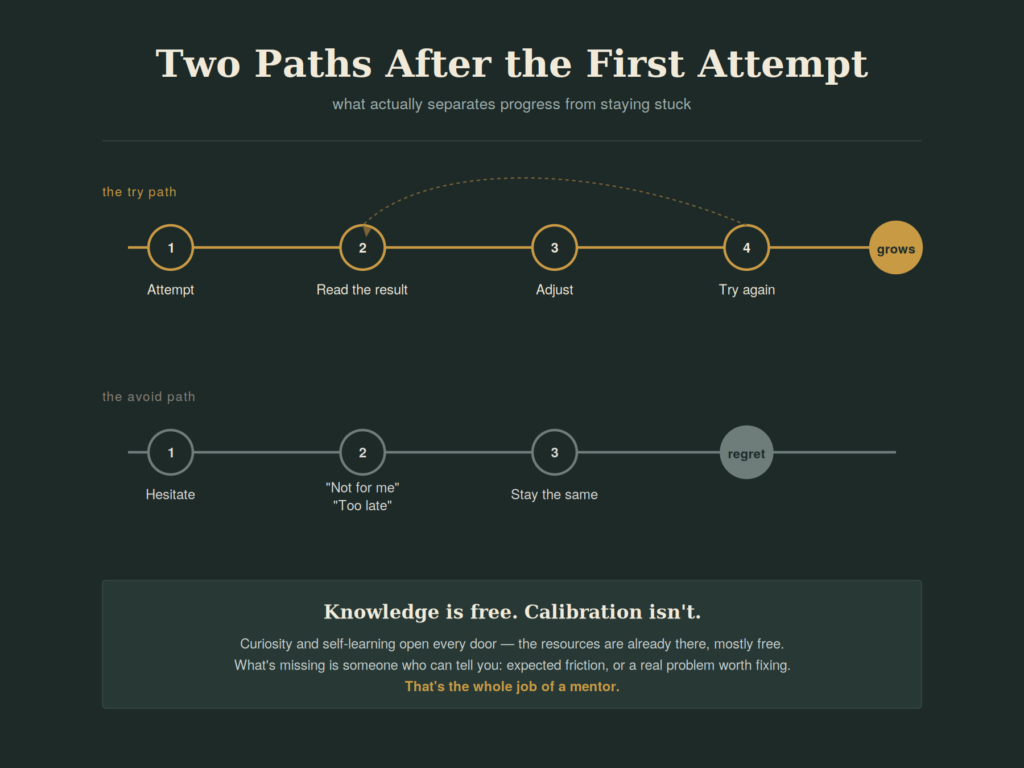
I told him something I say often now: trying and failing is progress. Not trying at all is the actual failure.
He tried again. He’s still figuring it out. But he’s figuring it out — which is the entire point.
The two quiet lies
I see a version of this story constantly, and it usually hides behind one of two lines people tell themselves:
“I guess this isn’t for me.”
One attempt gets treated as a verdict on ability, when it was really just a test of one specific approach, on one specific day, in front of one specific audience. It’s data about *that attempt* — not about the person’s capacity for the whole domain.
“It’s too late for me to start.”
This one is rarely about age or timing. It’s usually about status — the discomfort of being visibly bad at something new when you’re already competent everywhere else. That’s not a character flaw. It’s just an uncomfortable, very normal feeling that gets mistaken for a fact about what’s still possible.
Both lines feel true in the moment. Neither one is information. They’re just the emotional residue of having taken a risk.
What’s actually changed
Here’s the part I think matters most right now: in a world of ever-growing complexity, curiosity and the ability to teach yourself have become the core skill — arguably the core skill. Almost anything you’d want to learn is documented, demonstrated, and explained somewhere, and most of it costs nothing. Hard skills are, in a very real sense, no longer the bottleneck for someone who’s capable and willing to look.
So if the knowledge is free and everywhere, what’s actually scarce?
The piece that’s still missing
What’s missing isn’t information. It’s someone who can look at an attempt and tell you which kind of failure you just had.
There are two very different kinds:
-
- Expected friction — the normal roughness of a first try, which just needs another rep.
-
- A real problem — something structurally off that will keep producing the same result no matter how many times you repeat it.
Self-study, on its own, often can’t tell these apart. That’s not a failure of the learner — it’s just very hard to see your own blind spots from inside them. This is the actual job of a good mentor or coach: not motivating someone to keep going, and not handing them content they could find themselves, but calibrating what an attempt actually means and helping them see the path forward.
Without that calibration, people tend to fail in one of two directions: they quit too early on ordinary friction that a bit more repetition would have solved, or they persist for too long down a path that was never going to work, because nothing told them which kind of failure they were having.
The actual shift
If there’s one adjustment I’d ask people to make, it’s this: stop asking “did I fail?” and start asking “what did this attempt just teach me, and who can help me read it correctly?”
Trying and failing is progress. Not trying is the failure. But even trying works best with someone in your corner who can tell you what your failure actually means.
If you’re sitting on an attempt you’re not sure how to read — whether it was normal friction or a real signal to change course — that’s exactly the kind of thing a short discovery conversation can untangle. Happy to be that second set of eyes.
I write about agility, leadership and coaching. I work with leaders to help with that shift. If this resonated, get in touch to talk through what it could look like for you or your team.