
When Middle Managers Become Messengers
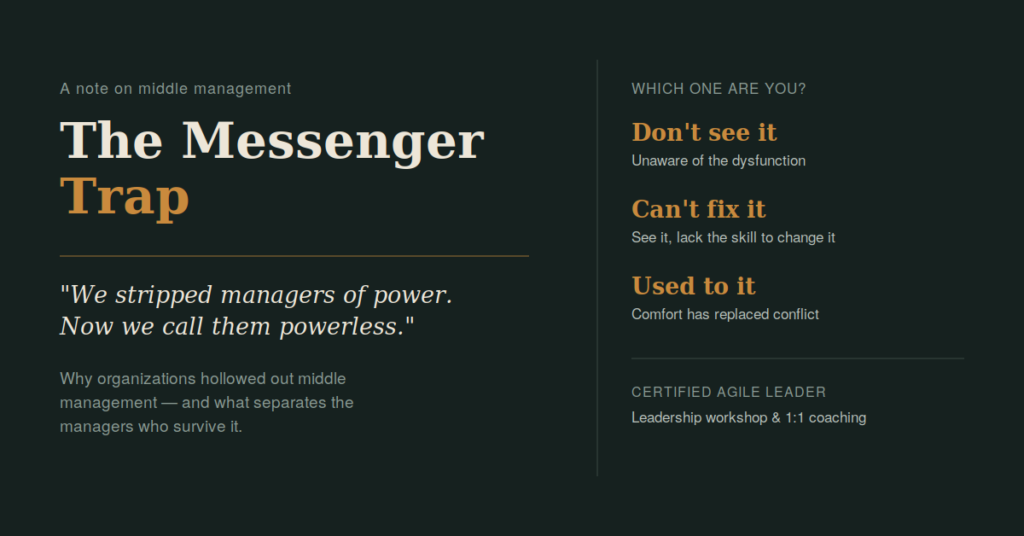
For years, many organizations turned managers into messengers. They had the title. They attended the meetings. They managed the team. But when it came to the decisions that actually mattered, they often had very little authority.
Information went down.
Numbers went up.
And the manager sat somewhere in the middle, translating one side to the other.Then something interesting happened.
Organizations began asking:
“What value do our middle managers actually add?”
The irony is hard to miss. We created management roles with limited authority and limited influence—and then wondered why those roles weren’t creating much impact.
The problem isn’t always the manager
In my leadership sessions, I regularly see managers beginning to recognize this. They know that their title alone won’t protect their career. Being liked by their team isn’t enough. Being good at communicating updates isn’t enough. And being the person who reliably forwards information between senior leadership and the team isn’t leadership.
Real leadership starts when you can influence what happens, not simply communicate what someone else has decided. But there is another realization that often comes up.Managers start seeing their organization differently.They notice the contradictions.Decisions that don’t make sense. Problems everyone knows about but nobody wants to discuss.Processes that continue simply because “that’s how we’ve always done it.”
Senior leaders asking for accountability without giving people the authority to act. Teams being told to innovate while being punished for taking risks.
And eventually, the manager has to confront a difficult question:
Is my organization dysfunctional—or have I simply become comfortable with the dysfunction?
Three possibilities
When dysfunction becomes visible, there are usually three possibilities.
1. Leadership genuinely doesn’t see it. The people at the top may simply be too far removed from the day-to-day reality.
2. Leadership sees it but doesn’t know how to change it. The problem is visible, but changing the system is difficult, politically expensive, or uncomfortable.
3. Leadership sees it and has simply learned to live with it. This is the most dangerous one.
Because when dysfunction becomes normal, people stop experiencing it as dysfunction.
They call it:
- “How things work here.”
- “It’s just the culture.”
- “Don’t rock the boat.”
- “That’s above my level.”
- “We’ve tried that before.”
And eventually, the manager stops challenging the system too.
That’s where careers quietly stall
Comfort with dysfunction can look like patience. It can look like being a team player. It can even look like maturity. But sometimes it is simply career stagnation disguised as stability. The manager becomes very good at operating inside the system without ever becoming capable of influencing the system.
And that is a dangerous place to stay. Because organizations increasingly need managers who can do more than administer. They need people who can make decisions in ambiguity. Build influence without relying entirely on positional authority. Challenge assumptions. Surface problems. Navigate conflicting interests.
And help people move toward a better outcome—even when nobody has handed them a perfect answer.
What I work on with managers
This is what I focus on in my leadership sessions. Not leadership as a collection of inspirational qualities. Not “soft skills” in isolation. But the practical capabilities that allow a manager to become someone who creates movement.
We work on things like:
- Building influence without depending on hierarchy
- Making decisions instead of simply carrying decisions
- Challenging assumptions and organizational narratives
- Naming dysfunction rather than quietly absorbing it
- Handling difficult conversations
- Creating trust while still challenging people
- Becoming someone people choose to follow—not simply someone they report to
And there is usually a moment when something changes.
The manager stops asking:
“How do I survive in this organization?”
and starts asking:
“How can I actually influence what happens here?”
That is a very different leadership mindset.
If you’re a manager wondering whether you’re genuinely building leadership capability—or simply getting better at operating inside a dysfunctional system—it may be worth having a conversation.
I run leadership workshops and offer 1:1 coaching for managers who want to lead, not just relay.