CSM Certification Training In Lucknow
CSM Certification Training In Lucknow helps professionals to understand Scrum principles, Agile practices, and effective team collaboration. The CSM training enhances leadership, communication, and project management skills. CSM Certification Training In Lucknow is ideal for Scrum Masters, project managers, and Agile enthusiasts seeking career growth and industry recognized certification.

Key Features
- 🎓 2 Days of Online Live Virtual Class
- 🧑💼 Two-year membership in Scrum Alliance
- 📜 CSM certification fee included
- 🌍 Get Trained by globally acclaimed Certified Scrum Trainer (CST)
- 📚 20 PDUs and SEUs
- 📝 2 Free exam attempts within 90 days
- 💯 100% Money Back guarantee on CSM exam
Our Contacts
For any queries & discount please contact
Meghana : +91-7892945526
Happy : +91-9148370043
Drop us your query on - trainings@poweragile.com
For Corporate Training
( Business, Teams or Group of Learners)
Our Upcoming Trainings Calendar
*Scroll left to get registration link
Get In Touch With Us

CSM Training Overview
CSM Certification Training In Lucknow provides a strong foundation in Scrum and Agile practices that are widely used in modern project management. Scrum is a lightweight framework designed to help teams to deliver high value products through collaboration, transparency, and continuous improvement. It enables teams to adapt quickly to changing requirements while maintaining productivity and quality.
The Agile methodology is a flexible approach to project management that focuses on customer satisfaction, iterative development, and rapid delivery of valuable outcomes. Agile encourages teamwork, continuous feedback, and adaptability. Scrum is one of the most popular Agile frameworks, because it offers a structured yet flexible way to manage projects and improve team performance.
In today's fast changing business environment, Scrum plays a critical role in ensuring project success. Organizations use Scrum to manage complex projects, improve communication, reduce risks, and increase efficiency. By applying Scrum principles, teams can respond effectively to market changes and customer needs while delivering quality products within shorter timelines.
CSM Certification Training In Lucknow helps professionals to gain practical knowledge of Scrum roles, events, and artifacts. The CSM training enhances leadership abilities, problem solving skills, and team collaboration techniques. Participants learn how to facilitate Scrum processes and support Agile transformation within their organizations. These skills make professionals valuable assets in competitive industries.
After completing CSM Certification Training In Lucknow, professionals can explore various career opportunities such as Scrum Master, Agile Coach, Project Manager, Product Owner, Business Analyst, and Team Lead. The demand for certified Scrum professionals continues to grow across industries including information technology, finance, healthcare, manufacturing, and consulting.
The Scrum Master certification is globally recognized and respected by organizations worldwide. It demonstrates a professional's commitment to Agile excellence and continuous learning. Employers often prefer certified candidates because they possess proven knowledge of Scrum practices and can contribute effectively to Agile project success.
Who Should Attend CSM Training?
1. Agile Team Members
2. Project Delivery Managers
3. Application Developers
4. Product Strategy Professionals
5. Requirements Gathering Specialists
6. Testing And Validation Experts
7. Entry Level Professionals
8. Product Vision Owners
9. Future Scrum Masters
10. Enterprise Transformation Advisors
Benefits Of CSM Training:
1. Enhanced Career Opportunities
2. Improved Income Prospects
3. Advanced Scrum Knowledge
4. Effective Team Leadership
5. Optimized Workflow Efficiency
6. Industry Recognized Certification
7. Strong Communication Skills
8. Successful Sprint Execution
9. Expanded Job Possibilities
10. Continuous Career Development
Pre-requisites:
1. Basic Agile Understanding
2. Scrum Learning Interest
3. Strong Communication Abilities
4. Team Collaboration Mindset
5. Project Management Awareness
Facilitation Skills For Scrum Masters In Lucknow
Facilitation skills are essential for Scrum Masters who want to guide teams toward successful project outcomes. Through CSM Certification Training In Lucknow, professionals learn how to facilitate discussions, encourage collaboration, and create an environment where teams can perform effectively. Strong facilitation skills help Scrum Masters ensure that meetings remain productive, focused, and aligned with project goals.
Meeting facilitation techniques are a key part of Scrum practices. Scrum Masters are responsible for conducting Sprint Planning, Daily Scrum, Sprint Review, and Sprint Retrospective meetings. Effective facilitation ensures that discussions stay on track, objectives are achieved, and all participants understand their responsibilities. CSM Certification Training In Lucknow provides practical methods for organizing meetings, managing time, and encouraging constructive communication among team members.
Active listening skills are equally important for Scrum Masters. Listening carefully helps identify concerns, understand team challenges, and gather valuable insights from stakeholders. Active listening involves paying full attention, asking relevant questions, and providing meaningful feedback. These skills improve communication and strengthen trust within Agile teams.
Conflict resolution methods are another critical aspect of facilitation. Team disagreements can arise due to differing priorities, technical opinions, or resource constraints. Scrum Masters must address conflicts professionally and help team members find mutually beneficial solutions. By applying structured conflict resolution techniques, teams can maintain a positive work environment and continue focusing on project objectives.
Encouraging team participation is essential for creating an inclusive Agile culture. Scrum Masters motivate all team members to contribute ideas, share feedback, and participate in decision making processes. When everyone is actively involved, teams benefit from diverse perspectives, increased engagement, and stronger ownership of project outcomes.
Decision making facilitation helps teams evaluate options and reach agreements efficiently. Scrum Masters guide discussions, clarify objectives, and ensure that decisions align with business goals and team priorities. Effective decision making reduces delays and supports continuous progress throughout the project lifecycle.
Workshop management skills further enhance a Scrum Master’s effectiveness. Workshops are often used for brainstorming, problem solving, planning, and process improvement activities. CSM Certification Training In Lucknow equips professionals with techniques to design, organize, and facilitate engaging workshops that deliver meaningful results and support continuous improvement across Agile teams.
Coaching Skills For Scrum Masters In Lucknow
Coaching skills are a vital component of a Scrum Master’s responsibilities. Beyond facilitating meetings and managing Scrum events, Scrum Masters act as coaches who help teams improve performance, embrace Agile values, and achieve continuous growth. CSM Certification Training In Lucknow provides comprehensive knowledge of coaching techniques that enable professionals to guide teams and organizations toward Agile excellence.
Agile coaching fundamentals focus on helping individuals and teams understand Agile principles and apply them effectively in daily work. Scrum Masters learn how to identify improvement opportunities, encourage collaboration, and foster a mindset of continuous learning. Through CSM Certification Training In Lucknow, participants gain practical coaching approaches that support successful Agile implementation across different project environments.
Mentoring team members is another important aspect of Scrum coaching. Scrum Masters help individuals develop their skills, overcome challenges, and improve their understanding of Agile practices. Effective mentoring creates confidence, increases accountability, and encourages professional development. By supporting team members through guidance and feedback, Scrum Masters contribute to stronger team performance and better project outcomes.
Building high performance teams requires continuous coaching and support. Scrum Masters encourage trust, transparency, and open communication among team members. They help teams establish clear goals, improve collaboration, and develop self management capabilities. High performing teams are better equipped to handle complex projects, adapt to changing requirements, and deliver consistent value to customers.
Encouraging Agile adoption throughout the organization is another key coaching responsibility. Scrum Masters help employees understand the benefits of Agile practices and guide them through the transition process. They address concerns, provide education, and create awareness about Agile frameworks. Successful Agile adoption often depends on effective coaching and consistent support from experienced Scrum professionals.
Coaching leadership teams is equally important for long term Agile success. Leaders play a significant role in shaping organizational culture and supporting Agile initiatives. Scrum Masters work closely with managers and executives to promote Agile thinking, improve decision making processes, and align business objectives with Agile principles.
Supporting organizational growth is the ultimate goal of Agile coaching. By helping teams and leaders embrace continuous improvement, Scrum Masters contribute to greater efficiency, innovation, and adaptability. CSM Certification Training In Lucknow equips professionals with the coaching skills needed to drive positive change, strengthen Agile practices, and support sustainable organizational development.
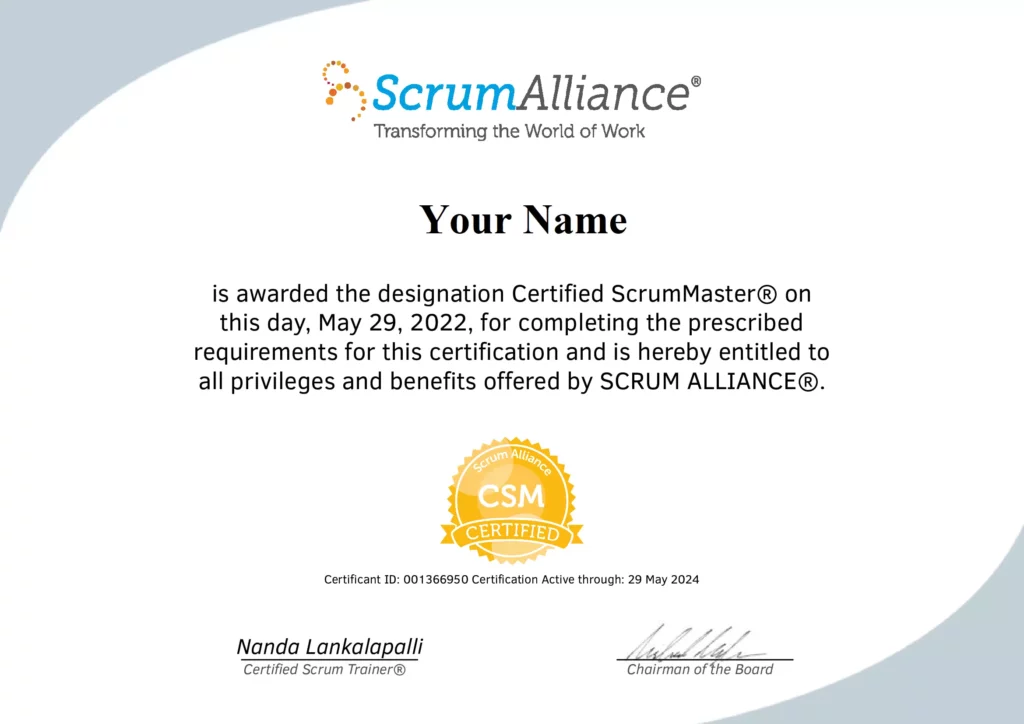
CSM Sample Certificate
Conflict Resolution In Scrum Teams In Lucknow
Conflict resolution is an important responsibility of Scrum Masters because team conflicts can impact productivity, collaboration, and project success. Agile teams often work in fast paced environments where different opinions and perspectives are common. CSM Certification Training In Lucknow helps professionals develop the skills needed to identify, manage, and resolve conflicts while maintaining a positive and collaborative team culture.
Understanding the types of team conflicts is the first step toward effective resolution. Conflicts may arise due to communication gaps, differing technical approaches, unclear responsibilities, competing priorities, or personality differences. While some conflicts can create healthy discussions and innovation, unresolved conflicts may negatively affect team performance. Scrum Masters learn how to distinguish between constructive and destructive conflicts to respond appropriately.
Conflict identification methods help Scrum Masters recognize issues before they escalate. Observing team interactions, monitoring participation during meetings, and encouraging open communication can reveal underlying concerns. Regular Scrum events such as Daily Scrums and Retrospectives provide valuable opportunities to identify disagreements and address challenges early. CSM Certification Training In Lucknow teaches practical techniques for detecting and understanding the root causes of team conflicts.
Resolution strategies focus on finding solutions that satisfy all parties while maintaining project objectives. Scrum Masters facilitate discussions, encourage active listening, and guide team members toward mutually beneficial outcomes. They help clarify misunderstandings, promote transparency, and ensure that decisions are based on facts rather than emotions. Effective conflict resolution strengthens trust and improves collaboration within Agile teams.
Facilitating healthy discussions is another critical skill for Scrum Masters. Open and respectful communication allows team members to express ideas, share concerns, and explore different viewpoints. Scrum Masters create a safe environment where everyone feels comfortable contributing to discussions. This approach encourages innovation, improves problem solving, and helps teams reach better decisions.
Building positive relationships within the team is essential for long term success. Scrum Masters promote respect, empathy, and teamwork among members. Strong relationships improve communication, increase trust, and reduce the likelihood of misunderstandings. When team members work well together, they can collaborate more effectively and achieve shared goals.
Preventing recurring conflicts requires continuous improvement and proactive communication. Scrum Masters encourage feedback, establish clear expectations, and address issues before they become major problems. CSM Certification Training In Lucknow equips professionals with proven conflict management techniques that support healthy team dynamics, stronger collaboration, and sustainable Agile success.
Risk Management In Agile Projects In Lucknow
Risk management is a critical component of Agile project success. Agile environments often involve changing requirements, evolving customer expectations, and dynamic business conditions. Effective risk management helps teams identify potential challenges early and respond quickly to minimize negative impacts. CSM Certification Training In Lucknow provides professionals with practical knowledge and techniques to manage risks efficiently while maintaining project momentum and delivering value.
Risk identification techniques are essential for recognizing potential issues before they affect project outcomes. Agile teams use brainstorming sessions, Sprint Planning meetings, Retrospectives, and stakeholder discussions to uncover possible risks. These risks may include technical challenges, resource limitations, communication issues, or changing business priorities. Early identification allows teams to prepare appropriate responses and avoid costly disruptions later in the project lifecycle.
Risk assessment methods help teams evaluate the likelihood and impact of identified risks. Scrum Masters and Agile teams analyze risks to determine which ones require immediate attention and which can be monitored over time. Prioritizing risks ensures that resources are focused on the most significant threats to project success. CSM Certification Training In Lucknow teaches professionals how to assess risks effectively and make informed decisions based on project objectives.
Risk mitigation strategies involve creating action plans to reduce the probability or impact of risks. Agile teams often address risks by improving communication, increasing collaboration, conducting regular reviews, and breaking work into smaller manageable increments. Frequent feedback and continuous testing also help identify and resolve issues before they become major problems. These proactive measures contribute to smoother project execution and better outcomes.
Managing uncertainty is an important aspect of Agile project management. Since requirements and market conditions can change rapidly, Agile teams must remain flexible and adaptable. Scrum Masters help teams embrace uncertainty by encouraging transparency, continuous learning, and collaborative problem solving. This approach enables teams to respond effectively to unexpected situations while maintaining productivity.
Adaptive planning approaches support Agile teams in handling changing circumstances. Instead of relying on rigid long term plans, Agile projects use iterative planning and regular reviews to adjust priorities and strategies as needed. This flexibility helps teams stay aligned with customer needs and business goals throughout the project.
Continuous risk monitoring ensures that risks remain visible and manageable throughout the project lifecycle. Teams regularly review potential threats, evaluate mitigation efforts, and identify emerging concerns. CSM Certification Training In Lucknow equips professionals with the skills needed to implement effective risk management practices, support Agile adaptability, and achieve successful project delivery.
Agile Quality Management In Lucknow
Agile Quality Management In Lucknow focuses on ensuring that products and services consistently meet customer expectations while maintaining high standards throughout the development process. Quality is not treated as a separate activity in Agile projects but is integrated into every stage of development. CSM Certification Training In Lucknow helps professionals understand how Agile teams maintain quality through collaboration, continuous feedback, and iterative improvement.
The importance of quality in Agile cannot be overstated. Delivering high quality products increases customer satisfaction, strengthens business reputation, and reduces the cost of rework. Agile teams prioritize quality from the beginning by defining clear acceptance criteria, maintaining transparency, and ensuring that every increment meets established standards. This proactive approach helps organizations deliver reliable solutions while adapting to changing requirements.
Testing strategies play a vital role in Agile quality management. Agile teams perform testing throughout the development cycle rather than waiting until the end of a project. Functional testing, regression testing, user acceptance testing, and automated testing help identify issues early. Continuous testing allows teams to validate product functionality regularly and ensure that new features do not negatively impact existing capabilities.
Continuous integration practices further strengthen quality management efforts. Developers frequently integrate code changes into a shared repository where automated builds and tests are executed. This process helps detect defects quickly and ensures that software remains stable throughout development. CSM Certification Training In Lucknow introduces professionals to Agile practices that support seamless integration and reliable product delivery.
Defect prevention techniques focus on avoiding problems before they occur. Agile teams use code reviews, pair programming, clear requirements, and regular communication to reduce the likelihood of errors. Early feedback from stakeholders and team collaboration also contribute to identifying potential issues before they become significant challenges.
Quality assurance processes in Agile emphasize shared responsibility. Every team member contributes to maintaining quality by following best practices, participating in reviews, and ensuring that deliverables meet agreed standards. Continuous monitoring and validation help teams maintain consistency and improve overall product performance.
Continuous improvement of quality is a fundamental Agile principle. Teams regularly evaluate their processes during Retrospectives and identify opportunities for enhancement. By learning from previous experiences and implementing improvements, organizations can achieve higher levels of quality over time. CSM Certification Training In Lucknow equips professionals with the knowledge and skills needed to establish effective quality management practices and support long term Agile success.
Scrum In Different Industries In Lucknow
Scrum has evolved beyond software development and is now widely used across various industries to improve efficiency, collaboration, and project outcomes. Organizations adopt Scrum, because of its flexibility, transparency, and ability to respond quickly to changing requirements. CSM Certification Training In Lucknow helps professionals understand how Scrum principles can be successfully applied in different sectors to achieve business objectives and drive continuous improvement.
Scrum in Information Technology remains one of the most common applications of the framework. Technology companies use Scrum to manage software development projects, improve product quality, and accelerate delivery cycles. Agile teams collaborate closely, deliver incremental improvements, and respond effectively to customer feedback. This approach helps organizations remain competitive in rapidly changing markets.
Scrum in the banking sector has gained significant popularity as financial institutions focus on digital transformation and customer centric services. Banks use Scrum to develop mobile applications, improve online banking platforms, and streamline internal processes. Agile practices help teams adapt to regulatory changes, enhance customer experiences, and deliver innovative financial solutions more efficiently.
Scrum in the healthcare industry supports the development of healthcare technologies, patient management systems, and operational improvements. Healthcare organizations use Scrum to improve communication, manage complex projects, and deliver solutions that meet evolving patient and regulatory requirements. Agile approaches enable healthcare teams to respond quickly to industry changes while maintaining quality and compliance.
Scrum in manufacturing helps organizations optimize production processes, improve collaboration among departments, and enhance product development activities. Manufacturing teams use Scrum to manage innovation projects, reduce waste, and increase operational efficiency. Regular reviews and continuous improvement practices support better decision making and faster delivery of business value.
Scrum in the education sector is increasingly being used to improve curriculum development, administrative processes, and collaborative learning initiatives. Educational institutions apply Agile principles to manage projects more effectively, encourage teamwork, and adapt to changing educational needs. Scrum helps educators and administrators achieve goals while maintaining flexibility and transparency.
Scrum in government projects supports the delivery of public services, technology initiatives, and policy implementation programs. Government agencies use Scrum to improve project visibility, enhance stakeholder engagement, and manage changing requirements effectively. Agile practices help public sector organizations deliver results more efficiently while maintaining accountability and transparency.
CSM Certification Training In Lucknow provides professionals with the skills needed to apply Scrum across diverse industries, enabling organizations to improve performance, foster innovation, and achieve sustainable success through Agile project management practices.
Remote Scrum Team Management In Lucknow
Remote Scrum Team Management In Lucknow has become increasingly important as organizations embrace flexible work environments and global collaboration. Managing remote Agile teams requires effective communication, strong leadership, and the ability to maintain productivity across different locations. CSM Certification Training In Lucknow equips professionals with the knowledge and skills needed to successfully lead distributed Scrum teams while ensuring alignment with project goals and Agile principles.
Managing distributed teams presents unique challenges such as time zone differences, communication barriers, and limited face to face interactions. Scrum Masters play a vital role in ensuring that team members remain connected and focused on shared objectives. By establishing clear expectations, promoting transparency, and encouraging accountability, Scrum Masters help remote teams operate efficiently and deliver consistent results.
Remote communication practices are essential for maintaining collaboration and preventing misunderstandings. Scrum Masters encourage regular communication through video meetings, instant messaging platforms, and collaborative workspaces. Clear and timely communication helps team members stay informed about project progress, priorities, and challenges. CSM Certification Training In Lucknow teaches professionals how to implement communication strategies that support effective remote teamwork.
Virtual Scrum events are a key component of remote Agile project management. Sprint Planning sessions, Daily Scrums, Sprint Reviews, and Retrospectives can be conducted successfully through virtual platforms when facilitated effectively. Scrum Masters ensure that meetings remain interactive, productive, and focused on achieving specific objectives. Proper facilitation techniques help maintain engagement and encourage active participation from all team members.
Collaboration tools usage is critical for supporting remote Scrum teams. Digital platforms for project tracking, document sharing, communication, and task management enable teams to work together seamlessly regardless of location. Scrum Masters help teams select and use appropriate tools to improve visibility, coordination, and workflow efficiency.
Maintaining team engagement is another important responsibility for Scrum Masters. Remote work can sometimes lead to feelings of isolation or reduced motivation. Regular check ins, recognition of achievements, and opportunities for team interaction help create a positive and supportive work environment. Engaged team members are more likely to contribute effectively and remain committed to project success.
Building remote team culture requires continuous effort and strong leadership. Scrum Masters promote trust, collaboration, and shared values among team members. By fostering an inclusive and supportive culture, organizations can strengthen teamwork and improve performance. CSM Certification Training In Lucknow provides professionals with practical strategies for managing remote Scrum teams and achieving successful Agile outcomes in distributed work environments.
Scrum Master Certification Exam Preparation In Lucknow
Scrum Master Certification Exam Preparation In Lucknow is an important step for professionals who want to validate their Scrum knowledge and advance their Agile careers. Proper preparation helps candidates understand Scrum principles, improve confidence, and increase their chances of passing the certification exam successfully. CSM Certification Training In Lucknow provides structured learning and practical guidance that supports effective exam preparation.
Understanding the exam structure is essential before beginning the preparation process. Candidates should become familiar with the format, question types, scoring criteria, and certification requirements. Knowing what to expect during the examination helps reduce anxiety and allows candidates to focus their efforts on the most important topics. A clear understanding of the exam framework contributes significantly to successful performance.
Important Scrum concepts form the foundation of the certification examination. Candidates must understand Scrum values, roles, events, artifacts, and Agile principles. Topics such as Sprint Planning, Daily Scrum meetings, Sprint Reviews, Sprint Retrospectives, Product Backlog management, and servant leadership are commonly covered. CSM Certification Training In Lucknow provides comprehensive coverage of these concepts through practical examples and real world scenarios.
Sample questions practice plays a valuable role in exam preparation. Practicing mock tests and scenario based questions helps candidates evaluate their understanding and identify areas that require additional study. Regular practice also improves familiarity with question patterns and strengthens the ability to apply Scrum concepts effectively during the examination.
Exam preparation strategies help candidates organize their study plans efficiently. Creating a study schedule, reviewing course materials regularly, participating in discussions, and revisiting key concepts are effective preparation methods. Consistent learning and revision improve knowledge retention and build confidence before the examination date.
Time management techniques are crucial during the certification exam. Candidates should learn how to allocate time effectively, avoid spending too much time on individual questions, and maintain a steady pace throughout the test. Practicing timed assessments helps develop the ability to answer questions accurately within the available timeframe.
Certification success tips include maintaining a positive mindset, reviewing Scrum fundamentals thoroughly, and focusing on practical understanding rather than memorization. Active participation during training sessions and continuous practice can significantly improve exam readiness. CSM Certification Training In Lucknow equips professionals with the knowledge, confidence, and preparation techniques needed to successfully achieve Scrum Master certification and advance their Agile career journey.
CSM Training In Lucknow FAQ:
What is CSM Training In Lucknow?
CSM Training In Lucknow teaches Scrum and Agile project management skills.
Who can join CSM Training In Lucknow?
IT professionals, managers, developers, and fresh graduates can join.
What are the benefits of CSM certification?
It improves career growth, leadership skills, and job opportunities.
Is CSM Training In Lucknow suitable for beginners?
Yes, beginners can easily learn Scrum fundamentals and Agile concepts.
How long is CSM Training In Lucknow?
Most training programs are completed within two to three days.
What is taught in CSM Training In Lucknow?
Scrum framework, sprint planning, Agile practices, and team management are taught.
Why Choose Us ?
- Activity Based Learning
- Get Opportunity to trained with India’s 1st CST who is eligible to Certify you on all six Modules of Scrum Alliance Courses, (CSM + A-CSM + CSP-SM + AISM + CAL-1)
- We believe in 100% Customer Satisfaction, If you don’t Like our Trainings, Talk to our team Immediately, 100% refund, No question asked.
- Career Guidence Support 24*7 – via chat, email and phone : Assistance with Scrum Alliance Exam Registration process, For knowledge sharing, Exam tips,Access to Local study groups.
Enroll Now & Get 5 FREE Video Courses

Our Students Say..
All the best Nanda!!