CSM Certification Training In Japan
CSM Certification Training In Japan helps professionals to build strong Agile and Scrum skills for modern workplaces. CSM Certification Training In Japan enhances project delivery, teamwork, and leadership capabilities across industries. It is ideal for aspiring Scrum Masters, project managers, and Agile practitioners seeking global career opportunities and professional growth in Japan’s competitive market.

Key Features
- 2 Days of Online Live Virtual Class
- Two-year membership in Scrum Alliance
- CSM® exam fee included
- Get trained by globally acclaimed Certified Scrum Trainer (CST)
- 20 PDUs and SEUs
- 2 Free exam attempts within 90 days.
- 100% Money Back guarantee on CSM exam
Our Contacts
For any queries & discount please contact
Meghana : +91-7892945526
Happy : +91-9148370043
Drop us your query on - trainings@poweragile.com
For Corporate Training
( Business, teams or Group of Learners)
Our Upcoming Trainings Calendar
*Scroll left to get registration link
Get In Touch With Us
CSM Certification Course Overview
CSM Certification Course Overview highlights how Agile practices are transforming project management across industries. CSM Certification Training In Japan provides a structured path to understand Scrum principles, roles, and frameworks that support efficient teamwork and faster delivery. Organizations across technology, finance, manufacturing, and services are increasingly adopting Agile methods to stay competitive and respond quickly to market changes. This growing shift makes Scrum knowledge highly valuable for professionals working in Japan.
Overview of Agile adoption in Japan shows steady growth as companies focus on innovation, flexibility, and customer centric development. Many Japanese organizations are blending traditional management approaches with Agile frameworks to improve productivity and reduce project risks. CSM Certification Training In Japan helps learners to understand how to apply Agile concepts in real world scenarios while respecting organizational processes and continuous improvement practices.
Growing demand for Scrum professionals in Japan is driven by digital transformation and global collaboration. Companies are actively seeking skilled Scrum Masters, who can guide teams, remove obstacles, and ensure smooth project execution. The importance of CSM certification for modern workplaces in Japan lies in validating practical knowledge, improving career prospects, and building credibility in Agile environments.
How Scrum supports Japanese business culture is evident through its focus on teamwork, transparency, respect, and continuous improvement. Scrum encourages collaboration and structured communication which aligns well with Japanese workplace values. Who should pursue CSM certification in Japan includes project managers, team leaders, software developers, business analysts, and professionals aiming to transition into Agile roles and enhance leadership skills.
Eligibility
1 Project Team Leads
2 Agile Practice Advisors
3 Product Strategy Managers
4 Software Testing Professionals
5 Process Improvement Experts
6 Delivery Program Heads
7 Startup Business Owners
8 Management Degree Holders
9 Multi Team Contributors
10 Future Scrum Professionals
Benefits
1 Develop Agile expertise
2 Advance Scrum capabilities
3 Boost team collaboration
4 Strengthen leadership skills
5 Broaden career prospects
6 Raise salary potential
7 Enhance decision making
8 Accelerate project delivery
9 Improve professional credibility
10 Encourage continuous growth
Why Get CSM Certified?
1 Demonstrate Agile proficiency
2 Validate Scrum knowledge
3 Guide efficient teams
4 Implement Agile practices
5 Improve stakeholder communication
6 Boost career growth
7 Build industry connections
8 Enhance income potential
9 Develop management perspective
10 Promote organizational agility
How Do You Get CSM Certified?
1 Register for training
2 Complete instructor sessions
3 Set up account
4 Access learning portal
5 Take certification test
6 Submit exam answers
7 Meet passing criteria
8 Agree certification terms
9 Verify profile details
10 Get official certificate
Why Choose CSM Certification Training In Japan?
Why Choose CSM Certification Training In Japan is a common question among professionals looking to build strong Agile capabilities in a globally respected business environment. CSM Certification Training In Japan provides structured learning that helps individuals understand Scrum principles, team collaboration, and adaptive project management. With Japan being known for innovation and operational excellence, learning Scrum in this environment allows professionals to gain insights into quality focused delivery and continuous improvement practices that are highly valued across industries.
Benefits of learning Scrum in Japan include exposure to disciplined workflows, strong teamwork culture, and a focus on efficiency. Professionals gain practical understanding of how Agile frameworks can be applied within structured organizations. This knowledge helps learners to improve productivity, enhance communication, and manage projects more effectively while adapting to changing business needs.
Career growth opportunities in Japan are expanding as companies continue digital transformation and adopt Agile methodologies. CSM Certification Training In Japan helps professionals qualify for roles such as Scrum Master, Agile Coach, project lead, and product specialist. Employers value certified professionals because they bring proven skills that support faster delivery, improved collaboration, and better project outcomes. It creates strong potential for career advancement and long term professional stability.
Industry recognition of CSM certification in Japan makes it a valuable credential for professionals, who want to stand out in competitive job markets. Organizations respect the certification because it demonstrates practical knowledge of Scrum practices and the ability to lead Agile teams. It also shows commitment to continuous learning and professional development which is highly appreciated by employers.
Practical knowledge gained through training in Japan focuses on real world scenarios, case discussions, and collaborative exercises. Networking opportunities in Japan also play a major role as professionals connect with trainers, peers, and industry experts. These connections can lead to knowledge sharing, career opportunities, and long lasting professional relationships that support ongoing growth in Agile careers.
Course Curriculum Of CSM Certification Training In Japan
Course Curriculum Of CSM Certification Training In Japan is designed to provide a complete understanding of Agile and Scrum concepts through structured learning and practical exercises. CSM Certification Training In Japan focuses on building strong foundations that help professionals to manage projects efficiently and lead teams with confidence. The curriculum blends theory with real world examples to ensure learners gain practical insights that can be applied across industries.
Introduction to Agile principles in Japan helps learners understand core values such as collaboration, flexibility, customer focus, and continuous improvement. Participants will also explore here how Agile supports modern organizations in delivering high quality products while adapting to changing requirements. Scrum framework deep dive in Japan explains the structure of Scrum including artifacts, events, and workflows that support iterative development and transparency.
The role of Scrum Master in Japan focuses on responsibilities such as facilitating communication, removing team obstacles, supporting collaboration, and ensuring adherence to Scrum practices. Learners will gain clarity on how Scrum Masters guide teams toward continuous improvement. Sprint planning practices in Japan teach participants how to define sprint goals, prioritize tasks, and create achievable plans that align with project objectives.
Daily Scrum facilitation in Japan emphasizes effective communication and progress tracking through short structured meetings. Participants will also learn techniques to encourage team accountability and transparency. Sprint review techniques in Japan cover methods to demonstrate completed work, gather stakeholder feedback, and improve product direction based on insights gained during reviews.
Sprint retrospective practices in Japan focus on continuous improvement by identifying successes, challenges, and actionable improvements after each sprint. Backlog refinement in Japan teaches how to prioritize tasks, clarify requirements, and maintain a well organized product backlog. CSM Certification Training In Japan provides comprehensive knowledge that equips professionals with practical skills to successfully implement Scrum and contribute to Agile transformation initiatives.
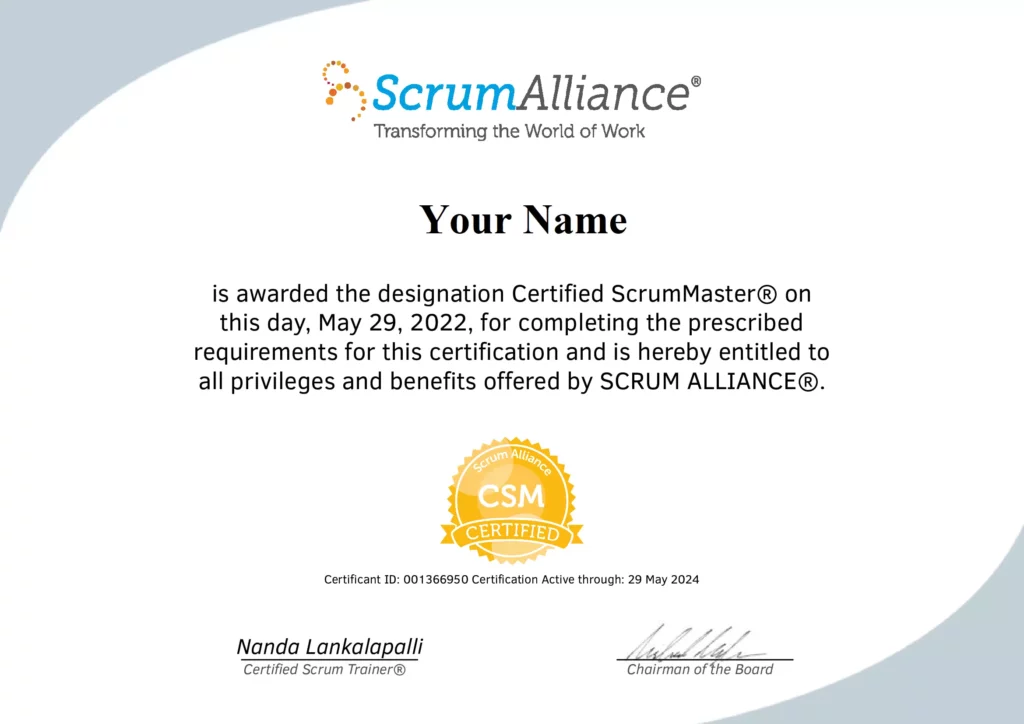
CSM Sample Certificate
Skills Developed During CSM Certification Training In Japan
Course Curriculum Of CSM Certification Training In Japan is designed to provide a complete understanding of Agile and Scrum concepts through structured learning and practical exercises. CSM Certification Training In Japan focuses on building strong foundations that help professionals to manage projects efficiently and lead teams with confidence. The curriculum blends theory with real world examples to ensure learners gain practical insights that can be applied across industries.
Introduction to Agile principles in Japan helps learners understand core values such as collaboration, flexibility, customer focus, and continuous improvement. Participants will also explore here how Agile supports modern organizations in delivering high quality products while adapting to changing requirements. Scrum framework deep dive in Japan explains the structure of Scrum including artifacts, events, and workflows that support iterative development and transparency.
The role of Scrum Master in Japan focuses on responsibilities such as facilitating communication, removing team obstacles, supporting collaboration, and ensuring adherence to Scrum practices. Learners will gain clarity on how Scrum Masters guide teams toward continuous improvement. Sprint planning practices in Japan teach participants how to define sprint goals, prioritize tasks, and create achievable plans that align with project objectives.
Daily Scrum facilitation in Japan emphasizes effective communication and progress tracking through short structured meetings. Participants will also learn techniques to encourage team accountability and transparency. Sprint review techniques in Japan cover methods to demonstrate completed work, gather stakeholder feedback, and improve product direction based on insights gained during reviews.
Sprint retrospective practices in Japan focus on continuous improvement by identifying successes, challenges, and actionable improvements after each sprint. Backlog refinement in Japan teaches how to prioritize tasks, clarify requirements, and maintain a well organized product backlog. CSM Certification Training In Japan provides comprehensive knowledge that equips professionals with practical skills to successfully implement Scrum and contribute to Agile transformation initiatives.
Certification Process For CSM In Japan
Certification Process For CSM In Japan explains the structured steps professionals follow to achieve globally recognized Scrum credentials. CSM Certification Training In Japan is designed to guide learners from enrollment to certification through a clear and supportive pathway. The process ensures candidates gain both theoretical knowledge and practical understanding of Scrum practices before earning their certification.
The registration process in Japan typically begins by selecting an approved training provider and enrolling in a scheduled CSM course. Candidates complete basic application details and receive access to learning materials and course information. CSM Certification Training In Japan helps participants to prepare through guided sessions, discussions, and real world examples that build confidence before the assessment stage.
Training attendance requirements in Japan are an essential part of the CSM certification journey. Participants are expected to attend instructor led sessions. Here they learn Scrum principles, team collaboration methods, and Agile practices. Active participation in discussions, exercises, and group activities helps learners to fully understand concepts and prepares them for real workplace scenarios.
The CSM examination format in Japan generally includes an online assessment that tests understanding of Scrum roles, events, artifacts, and Agile values. The CSM exam is designed to evaluate practical knowledge and decision making ability rather than memorization. Passing criteria in Japan requires achieving a minimum score that demonstrates clear understanding of Scrum concepts and their application in project environments.
CSM Certification validity in Japan ensures that professionals maintain up to date knowledge of Agile practices. After earning the credential, certified individuals may need to renew their certification periodically through continued learning or professional development activities. CSM Certification Training In Japan not only supports candidates in achieving certification, but also helps them build long term skills that support career growth, leadership development.
Career Opportunities After CSM Certification Training In Japan
Career Opportunities After CSM Certification Training In Japan are expanding as organizations continue to adopt Agile practices to improve efficiency and innovation. CSM Certification Training In Japan equips professionals with practical skills that are valued across industries such as technology, finance, manufacturing, and consulting. Certified individuals gain the ability to manage teams effectively, support collaboration, and drive successful project delivery which opens doors to diverse career paths.
Scrum Master roles in Japan are among the most common opportunities for certified professionals. In this role, individuals facilitate team activities, remove obstacles, and ensure that Scrum practices are followed effectively. Organizations rely on skilled Scrum Masters to improve productivity, enhance communication, and maintain smooth workflow within Agile teams.
Agile Coach roles in Japan offer opportunities for experienced professionals to guide multiple teams and support organizational Agile transformation. Agile Coaches help companies to adopt best practices, improve collaboration, and build a culture of continuous improvement. This role is ideal for professionals, who enjoy mentoring teams and driving strategic change within organizations.
Project Manager roles in Japan are also accessible after gaining Scrum knowledge. Professionals with CSM certification bring strong planning, communication, and risk management skills that help organizations to deliver projects efficiently. They can manage cross functional teams while ensuring alignment with business goals and customer expectations.
Product Owner opportunities in Japan are growing as companies focus on delivering customer centric products. Certified professionals can work closely with stakeholders to define product vision, prioritize features, and ensure value driven development. This role requires strong communication skills and a deep understanding of customer needs.
Consulting roles in Japan provide another career path for professionals, who want to help organizations improve processes and adopt Agile frameworks. Consultants analyze business challenges, recommend solutions, and guide teams toward better performance. Overall, CSM Certification Training In Japan creates strong career prospects by equipping professionals with skills that support leadership, collaboration, and successful project outcomes across industries.
Industries Hiring Scrum Masters In Japan
Industries Hiring Scrum Masters In Japan are expanding as organizations adopt Agile practices to improve efficiency, innovation, and customer satisfaction. CSM Certification Training In Japan prepares professionals with the skills needed to support Agile transformation across multiple sectors. Certified Scrum Masters help teams to collaborate effectively, manage projects smoothly, and deliver value faster which makes them highly valuable across industries.
The information technology sector in Japan is one of the largest employers of Scrum Masters due to rapid digital transformation and software development growth. Companies rely on Agile professionals to manage development cycles, improve product quality, and ensure faster delivery of digital solutions. Scrum practices help technology teams to respond quickly to changing customer needs and market trends.
The finance and banking sector in Japan is increasingly adopting Agile methods to improve service delivery, enhance digital platforms, and manage complex regulatory requirements. Scrum Masters support cross functional teams, improve communication, and help organizations deliver secure and reliable financial solutions while maintaining efficiency.
The automotive industry in Japan is globally recognized for innovation and quality. As automotive companies integrate software, automation, and smart technologies into vehicles, the need for Agile project management continues to grow. Scrum Masters help coordinate development teams, improve workflows, and support continuous improvement initiatives within automotive organizations.
The manufacturing sector in Japan is embracing Agile approaches to improve production planning, supply chain coordination, and product development. Scrum Masters help teams to collaborate across departments, reduce inefficiencies, and enhance operational performance. Agile practices support faster problem solving and continuous process improvement within manufacturing environments.
The healthcare industry in Japan is adopting Agile methods to improve patient care systems, digital health solutions, and operational efficiency. Scrum Masters help teams to manage projects that focus on improving service quality, implementing new technologies, and enhancing collaboration among healthcare professionals.
The telecommunications sector in Japan is another major employer of Scrum Masters as companies expand network infrastructure, develop digital services, and improve customer experience. Agile teams supported by Scrum Masters help telecom organizations to deliver reliable solutions and adapt quickly to evolving technology demands.
Salary Trends After CSM Certification Training In Japan
Salary Trends After CSM Certification Training In Japan reflect the growing demand for skilled Agile professionals across industries. CSM Certification Training In Japan helps individuals to gain practical knowledge and recognized credentials that support better earning potential. As organizations continue adopting Agile practices, certified professionals are able to secure competitive compensation packages along with strong career growth opportunities.
Entry level salary in Japan for professionals who have recently completed CSM certification typically depends on industry, company size, and prior experience. Individuals starting in junior Scrum or Agile support roles can expect steady growth as they gain hands-on experience and develop facilitation skills. Certification helps candidates to stand out during hiring and increases their chances of securing better starting packages.
Mid career salary in Japan generally increases significantly as professionals gain experience managing teams and delivering projects successfully. With a few years of experience, Scrum professionals often move into roles with greater responsibility such as leading multiple teams or handling complex projects. Organizations value experienced professionals, because they contribute to improved efficiency and better project outcomes.
Senior Scrum Master salary in Japan is typically higher due to leadership responsibilities and strategic involvement in organizational Agile transformation. Senior professionals guide teams, mentor other Scrum practitioners, and help organizations improve processes. Their expertise in stakeholder communication and continuous improvement contributes to higher compensation levels.
Factors affecting salary in Japan include level of experience, industry demand, company size, location, technical knowledge, and leadership skills. Professionals who continuously upgrade their skills and gain practical experience often see faster salary growth. Strong communication and problem solving abilities also play an important role in earning potential.
Comparison with other Agile roles in Japan shows that Scrum Masters often earn competitive salaries similar to project managers and Agile coaches, while product owners may earn comparable or slightly higher compensation depending on responsibilities. Overall, CSM Certification Training In Japan helps professionals to improve earning potential by equipping them with valuable Agile skills and recognized credentials that support long term career success.
Benefits Of Hiring Certified Scrum Masters In Japan
Benefits Of Hiring Certified Scrum Masters In Japan are increasingly recognized as organizations adopt Agile methods to improve efficiency and innovation. CSM Certification Training In Japan prepares professionals with strong facilitation, leadership, and problem solving skills that help teams to deliver projects successfully. Certified Scrum Masters bring structured processes, clear communication, and continuous improvement practices that support better business outcomes.
Improved project delivery in Japan is one of the key advantages of hiring certified Scrum professionals. They help teams plan effectively, prioritize tasks, and maintain transparency throughout the project lifecycle. By guiding teams through structured Scrum events and removing obstacles, Scrum Masters ensure that projects stay on schedule and meet quality expectations. This leads to faster delivery and reduced project delays.
Enhanced team collaboration in Japan is achieved through better communication and clear role understanding. Certified Scrum Masters encourage open discussions, promote teamwork, and ensure that team members remain aligned with project goals. Their ability to resolve conflicts and support a positive work environment leads to stronger relationships and improved teamwork across departments.
Higher productivity in Japan is supported by structured workflows and continuous improvement practices introduced by Scrum Masters. Teams are able to focus on high value tasks, minimize inefficiencies, and maintain consistent progress. Certified professionals help teams to track performance, identify improvements, and maintain momentum throughout development cycles.
Better risk management in Japan is another important benefit as Scrum Masters help identify potential challenges early and support proactive problem solving. They encourage regular reviews, feedback loops, and adaptive planning which helps organizations respond quickly to changes and reduce uncertainties during project execution.
Improved customer satisfaction in Japan is achieved through continuous feedback, iterative delivery, and strong focus on customer needs. Scrum Masters ensure that teams remain aligned with customer expectations and deliver high quality products or services. Overall, CSM Certification Training In Japan helps organizations to build stronger teams, improve project success rates, and achieve long term business growth through effective Agile practices.
Comparison Of CSM With Other Agile Certifications In Japan
Comparison Of CSM With Other Agile Certifications In Japan helps professionals to understand which credential aligns best with their career goals and learning needs. CSM Certification Training In Japan focuses on building a strong foundation in Scrum principles, team facilitation, and Agile mindset. It is widely recognized and often considered a starting point for professionals entering Agile roles across industries.
CSM vs PSM in Japan is a common comparison as both certifications focus on Scrum knowledge. CSM emphasizes interactive learning, instructor guidance, and practical exercises that help learners understand real world applications. PSM is more assessment focused and tests theoretical understanding of Scrum concepts. Many professionals choose CSM for its structured learning approach and collaborative training experience.
CSM vs PMI ACP in Japan highlights differences in scope and focus. CSM concentrates specifically on Scrum frameworks and team level practices, while PMI ACP covers a broader range of Agile methodologies including Kanban, Lean, and iterative development approaches. Professionals seeking deep Scrum expertise often prefer CSM, while those looking for broader Agile knowledge may consider PMI ACP.
CSM vs SAFe certification in Japan compares team level and enterprise level learning. CSM focuses on Scrum practices for individual teams. Hereas SAFe certification is designed for large organizations managing multiple Agile teams across complex projects. Professionals working in enterprise environments may pursue SAFe, while those focused on team facilitation roles often begin with CSM.
Which certification to choose in Japan depends on career goals, experience level, and industry requirements. CSM Certification Training In Japan is ideal for beginners, team leaders, and professionals transitioning into Scrum roles because it provides practical understanding and recognized credentials that support career growth.
Career impact comparison in Japan shows that CSM helps professionals enter Scrum Master or Agile team roles, while PMI ACP and SAFe may support broader project management or enterprise transformation positions. Overall, CSM Certification Training In Japan provides a strong starting point that builds essential Agile skills and opens pathways to advanced certifications and leadership opportunities.
Challenges Faced By Scrum Masters In Japan
Challenges Faced By Scrum Masters In Japan often arise as organizations transition from traditional project management approaches to Agile ways of working. CSM Certification Training In Japan prepares professionals to understand these challenges and develop strategies to address them effectively. Scrum Masters play a key role in guiding teams, promoting collaboration, and ensuring smooth adoption of Scrum practices while respecting organizational norms.
Cultural challenges in Japanese workplaces can influence how teams communicate and make decisions. Many organizations value hierarchy, consensus building, and structured processes which may slow decision making in Agile environments. Scrum Masters need to balance respect for workplace culture with the need for transparency and quick feedback cycles to ensure effective teamwork and progress.
Resistance to Agile adoption in Japan is another common challenge as some teams may prefer established workflows and traditional planning methods. Employees may initially feel uncertain about iterative development and flexible planning. Scrum Masters must educate stakeholders, demonstrate benefits through small successes, and gradually build trust in Agile practices to encourage acceptance and engagement.
Communication barriers in Japan can occur due to differences in communication styles, language preferences, and indirect feedback methods. Scrum Masters need to encourage open discussions, create safe environments for sharing ideas, and ensure that all team members feel comfortable expressing concerns. Clear communication practices help teams stay aligned and avoid misunderstandings.
Managing distributed teams in Japan can be complex as organizations often collaborate across different locations or time zones. Scrum Masters must ensure consistent communication, coordinate meetings effectively, and maintain team alignment despite physical distance. Using collaborative tools and structured processes helps teams remain connected and productive.
Balancing traditional and Agile practices in Japan requires careful adaptation as many companies combine established processes with modern frameworks. Scrum Masters must respect existing workflows while introducing Agile principles that support flexibility and continuous improvement. CSM Certification Training In Japan helps professionals develop the skills needed to navigate these challenges and lead successful Agile transformations while maintaining harmony within teams and organizations.
CSM Certification Training In Japan FAQ:
What is CSM Certification Training In Japan?
CSM Certification Training In Japan is a professional program. It teaches Scrum principles and prepares candidates for global certification.
Who should attend CSM Certification Training In Japan?
Project managers, developers, team leads, and aspiring Scrum Masters can attend CSM Certification Training In Japan.
What are the prerequisites for CSM Certification Training In Japan?
There are no strict prerequisites, but basic knowledge of Agile concepts is helpful.
How long is CSM Certification Training In Japan?
CSM Certification Training In Japan is 2 days long session.
Is the exam included in CSM Certification Training In Japan?
Yes, the exam is included in CSM Certification Training In Japan.
Is CSM Certification Training In Japan recognized globally?
Yes, CSM Certification Training In Japan is recognized globally
Can I attend CSM Certification Training In Japan online?
Yes, you can attend CSM Certification Training In Japan online.
What topics are covered in CSM Certification Training In Japan?
Scrum theory, roles, events, artifacts, and servant leadership practices topics are covered in CSM Certification Training In Japan.
How does CSM Certification Training In Japan help career growth?
CSM Certification Training In Japan enhances leadership skills and opens opportunities in Agile project management roles.
What industries value CSM Certification Training In Japan?
IT, banking, healthcare, government, logistics, and startups industries value CSM Certification Training In Japan.
Are there weekend batches for CSM Certification Training In Japan?
Yes, there are weekend and weekday both batches for CSM Certification Training In Japan.
Who provides CSM Certification Training In Japan?
Authorized certified trainers deliver CSM Certification Training In Japan.
Can fresh graduates join CSM Certification Training In Japan?
Yes, fresh graduates can join CSM Certification Training In Japan.
Can fresh graduates join CSM Training In Japan?
Yes, fresh graduates can join CSM Training In Japan.
What roles can I apply for after CSM Certification Training In Japan?
Scrum Master, Agile Coach, or project leadership roles you can apply for after CSM Certification Training In Japan.
Does CSM Certification Training In Japan improve leadership skills?
Yes, CSM Certification Training In Japan improves leadership skills.
Is CSM Certification Training In Japan suitable for non IT professionals?
Yes, CSM Certification Training In Japan is suitable for non IT professionals.
What is the validity of the CSM credential?
The validity of the CSM credential is 2 years.
Can companies arrange corporate sessions for CSM Certification Training In Japan?
Yes, PowerAgile arrange corporate sessions for CSM Certification Training In Japan.
Why Choose Us ?
- Activity Based Learning
- Get Opportunity to trained with India’s 1st CST who is eligible to Certify you on all six Modules of Scrum Alliance Courses, (CSM + A-CSM + CSP-SM + AISM + CAL-1)
- We believe in 100% Customer Satisfaction, If you don’t Like our Trainings, Talk to our team Immediately, 100% refund, No question asked.
- Career Guidence Support 24*7 – via chat, email and phone : Assistance with Scrum Alliance Exam Registration process, For knowledge sharing, Exam tips,Access to Local study groups.
Enroll Now & Get 5 FREE Video Courses




Our Students Say..
All the best Nanda!!