Certified Scrum Master® (CSM) Certification
CSM Certification equips professionals with essential Scrum skills, practical frameworks, and team collaboration techniques. It enhances Agile project delivery, builds leadership confidence. CSM Certification opens strong career opportunities in the fast growing Scrum and Agile industry.

Key Features
- 🎓 2 Days of Online Live Virtual Class
- 🧑💼 Two-year membership in Scrum Alliance
- 📜 CSM certification fee included
- 🌍 Get Trained by globally acclaimed Certified Scrum Trainer (CST)
- 📚 20 PDUs and SEUs
- 📝 2 Free exam attempts within 90 days
- 💯 100% Money Back guarantee on CSM exam
Our Contacts
For any queries & discount please contact
Meghana : +91-7892945526
Happy : +91-9148370043
Drop us your query on - trainings@poweragile.com
For Corporate Training
( Business, Teams or Group of Learners)
Our Upcoming Trainings Calendar
*Scroll left to get registration link
Get In Touch With Us

What is a CSM Certification?
CSM Certification (Certified ScrumMaster) is a globally recognized credential. It is offered by Scrum Alliance for professionals, who are seeking strong knowledge of Agile and Scrum. The CSM certification helps you to understand Scrum values, roles, events, and artifacts. It helps you to learn how to guide teams, remove obstacles, and improve workflow. With the help of CSM Certification, you will gain practical skills to enhance team collaboration, sprint planning, and product delivery. It is ideal for Scrum Masters, project managers, team leads, developers, and anyone shifting to Agile. Earning CSM Certification will boost your career growth, industry credibility, and salary prospects. It is one of the most preferred Agile certifications worldwide.
Who Should Attend Our CSM Course?
Our Certified ScrumMaster course is ideal for anyone looking to understand and implement the Scrum framework, including: Project Managers Team Leads Business Analysts Developers and Testers IT Professionals Anyone interested in pursuing a career in Agile project management.
Why Get CSM Certified?
1) Demonstrate your knowledge through the gold standard of agile certification.
2) Guide your team to effectively use Scrum and understand why Scrum values are so important.
3) Increase career opportunities and expand your professional community.
4) Improve leadership skills and influence organizational change.
How Do You Get Certified?
- After the CSM Training session, you will receive an email from Scrum Alliance that will include a link to create your login credentials.
- From the day you receive the email from Scrum Alliance, you will be given 90 days to take up the online examination.
- The first step will be to take the test. Once the test is complete, you will be asked to accept a license agreement and set up your online profile.
- The examination is open book, which you can take from your home, and it comes with two attempts that must be used within 3 months.
- The CSM test has a passing score of 37 out of 50 questions (Multiple Choice Format).
- You will receive the result immediately and can generate your CSM certificate from your Dashboard as a downloadable PDF file.
What Makes the CSM Certification Unique?
The CSM Certification (Certified ScrumMaster) is offered by Scrum Alliance. It stands out as one of the most respected and globally recognized Agile credentials. Scrum Alliance is a pioneer in promoting real-world Agile practices. It ensures that CSM holders meet international standards of Scrum excellence.
Unlike other Scrum certifications, CSM Certification focuses on experiential learning through interactive workshops, real world case studies, and live coaching by Certified Scrum Trainers (CSTs). This practical approach helps professionals truly master Scrum values, roles, and ceremonies, rather than just theoretical knowledge.
Top companies worldwide including Google, Amazon, Deloitte, and IBM prefer hiring CSM certified professionals. The CSM certification validates leadership, collaboration, and adaptability in dynamic Agile environments. It proves that you can manage teams efficiently, remove impediments. It ensures continuous improvement in product delivery.
Additionally, earning CSM Certification grants you membership with the Scrum Alliance. It offers access to a global community of Agile experts, exclusive learning resources, networking opportunities, and continuous professional development. This ongoing support helps professionals stay ahead of emerging Agile trends.
Why CSM Certification is Important for Professionals?
The CSM Certification (Certified ScrumMaster) has become a must have credential for professionals. It aims to thrive in Agile and project management roles. With the growing adoption of Agile frameworks across industries, the demand for certified Scrum Masters is rapidly increasing. Organizations are actively seeking professionals. It helps them to drive efficient teamwork, streamline workflows, and deliver high quality products faster using Scrum practices.
Earning a CSM Certification opens the door to significant career growth and salary benefits. Certified Scrum Masters often enjoy higher pay packages and faster promotions due to their proven ability to lead Agile teams and manage complex projects effectively. The CSM certification demonstrates leadership, collaboration, and adaptability skills highly valued in modern workplaces.
Today, industries such as IT, software development, finance, healthcare, telecom, e-commerce, and manufacturing are hiring Scrum Masters to support their Agile transformation journeys.
If you are a new professional, a mid level manager, or a senior leader, the CSM Certification helps you enhance your leadership capabilities. It improves project efficiency, and stay competitive in the job market. It provides a strong foundation in Agile principles.
CSM Certification Course Overview
The CSM Certification Course is a globally recognized training program By Scrum Alliance. It is designed to help professionals to master the Scrum framework and apply Agile principles effectively in real world projects. The CSM course follows a structured format that simplifies complex Scrum concepts while ensuring hands-on, practical learning. The structure of the CSM Certification Course includes instructor-led sessions, interactive discussions, group activities, Scrum simulations, and exam preparation guidance. Delivered by a Certified Scrum Trainer (CST). The CSM course ensures learners gain clarity on Scrum roles, events, artifacts, and the responsibilities of a successful Scrum Master.
The duration of the CSM Training is typically 2 full days (16 hours). PowerAgile offers extended learning support through pre class reading materials, post class mentoring, and mock tests. Online and classroom both CSM Certification options are available. It gives the flexibility to choose based on their preference. Online sessions are ideal for working professionals, who need convenience. Classroom training offers direct interaction and collaborative learning with peers.
The CSM course curriculum is broken down into essential modules such as Agile principles, Scrum theory, Scrum values, Scrum roles (Scrum Master, Product Owner, Development Team), Sprint flow, Product Backlog management, estimation techniques, facilitation methods, and coaching skills. These modules are designed to strengthen understanding and help learners apply Scrum confidently in their organizations.
The Key learning objectives of the CSM course is to enable the participants to support the Scrum team, remove impediments, facilitate collaboration, handle conflicts, guide teams during Sprint ceremonies, and promote continuous improvement.
The CSM course includes workshops, role play activities, and real case studies. It allows participants to practice Sprint Planning, Reviews, Retrospectives, and Daily Standups. These activities build confidence in handling real world scenarios.
Now participants will also receive course tools and resources. It includes workbooks, templates, mock exams, project examples, and lifetime access to certain learning materials. Study materials include the Scrum Guide, Agile practice questions, and reference notes provided by PowerAgile during the workshop.
The CSM Certification Course prepares learners not only for the exam, but also for practical success as effective Scrum Masters.
Benefits of CSM Certification
- CSM Certification boosts your career growth with stronger Agile and Scrum expertise.
- Enhances your earning potential with higher salary packages across IT industries.
- Increases your chances of getting hired due to rising demand for Scrum Masters.
- Gives you a competitive advantage in the job market compared to non certified peers.
- Strengthens your understanding of Agile values, principles, and frameworks.
- Improves your mastery of Scrum roles, events, and artifacts.
- Enhances your ability to use popular Agile tools like Jira, Trello, and Azure DevOps.
- Boosts leadership skills required to guide high performing Agile teams.
- Improves your facilitation skills for sprint planning, reviews, and retrospectives.
- Helps you resolve conflicts effectively within cross functional teams.
- Strengthens team collaboration through improved communication practices.
- Improves your ability to support product owners with backlog refinement.
- Helps you create predictable and sustainable delivery cycles.
- Increases your confidence to manage real world Agile project challenges.
- Opens opportunities in top companies hiring certified Scrum Masters.
- Offers global recognition since the CSM credential is valued worldwide.
- Expands your career options in IT, product development, and digital transformation.
- Helps you transition smoothly into roles like Agile Coach or Scrum Lead.
- Enables better understanding of team dynamics for improved productivity.
- Boosts your ability to remove blockers and support continuous improvement.
- Prepares you to adopt an Agile mindset that organizations demand.
- Increases project success rates through structured Scrum practices.
- Helps you facilitate daily standups with greater effectiveness.
- Teaches servant leadership, essential for guiding Agile teams.
Detailed CSM Certification Syllabus
The syllabus for CSM Certification is carefully designed to help learners to understand agile principles and master the Scrum framework in a practical and structured manner. The topics included in the CSM course provide a complete foundation for working effectively as a Scrum Master in any organisation. Each module focuses on real world applications, team collaboration, and agile delivery excellence.
The CSM syllabus begins with an introduction to agile and Scrum. Here learners will explore the evolution of agile, the Agile Manifesto, and the core values and principles that guide modern project management. This section also explains why Scrum is widely adopted and how it differs from traditional models.
A key part of the syllabus is the Scrum workflow explained in detail. It includes understanding Scrum roles, events, and artifacts. Learners will study here, how the Scrum Master facilitates the process, how the Product Owner manages value, and how the Development Team collaborates to deliver successful increments. The CSM workflow explanation ensures clarity on how work flows during each sprint.
The CSM next module focuses on the sprint life cycle and team responsibilities. This section covers sprint planning, daily Scrum, sprint execution, sprint review, and retrospective. Learners understand responsibilities such as removing impediments, defining sprint goals, promoting team transparency, and maintaining continuous improvement.
Another important topic is backlog refinement and prioritization. The CSM syllabus teaches how to create user stories, maintain a clear product backlog, apply prioritization techniques, and collaborate with stakeholders to ensure alignment. This module helps Scrum Masters to support the Product Owner more effectively.
The CSM course also covers scaling Scrum for large organizations. It introduces frameworks such as SAFe, LeSS, and Scrum at Scale. Learners will understand how Scrum can be adapted for enterprise level projects involving multiple teams.
Finally, the CSM syllabus includes an overview of tools used by Scrum Masters, such as Jira, Trello, Azure DevOps, and collaboration platforms that support agile delivery.
Preparation Strategy for CSM Certification
A well structured preparation strategy plays an important role in successfully clearing the CSM exam and building strong confidence in Scrum concepts. Although CSM Certification is beginner friendly. The right study approach will help learners to understand the framework deeply and apply its principles effectively. A mix of good study materials, practice tests, time management, and awareness of common mistakes ensures smooth exam preparation.
The first step is selecting study materials recommended for CSM Certification. Learners should review the Scrum Guide thoroughly. As it is the primary reference for the CSM exam. Trainer provided notes, course slides, and real world examples shared during the training sessions are valuable resources. Many candidates also use supplementary materials such as agile blogs, video tutorials, and community discussions to reinforce their understanding of roles, events, and artifacts.
Developing a plan for practice test planning is equally important. Taking mock tests helps you to identify knowledge gaps, strengthens recall, and improves familiarity with exam style questions. Test simulations allow candidates to refine their decision making based on Scrum values and real project scenarios. Reviewing incorrect answers will help you to reinforce difficult concepts.
Effective time management techniques can greatly enhance exam readiness. Learners should allocate focused study hours each day, revise key topics regularly, and break complex modules into smaller learning segments. Using short revision sessions, flashcards, and quick summaries can improve retention. During the exam, managing time wisely ensures that all questions are answered without rushing.
Candidates must also be aware of common mistakes to avoid during preparation. Many learners overlook the importance of understanding Scrum values and focus only on memorising processes. Another mistake is ignoring practical examples. It is essential for answering scenario based questions. Some candidates skip reviewing the Scrum Guide after training. Overconfidence or lack of revision can also lead to errors during the exam.
Overall, a solid preparation strategy will help learners to master key concepts and approach CSM Certification with confidence. It also improves their chances of success and enables them to apply Scrum effectively in their professional roles.
Salary Scope After CSM Certification
CSM Certification significantly enhances career prospects for professionals. It helps you to build a strong foundation in agile and Scrum practices. It is one of the most recognised credentials for individuals entering or advancing in agile project management. After completing CSM Certification, candidates can expect better salaries, wider job opportunities, and steady career growth across industries in India and global markets.
At the entry level, salary expectations for newly certified Scrum Masters generally fall in the range of moderate to competitive packages. It depends on the employer and technical background of the candidate. Freshers or professionals transitioning into Scrum roles can expect salaries that reflect foundational responsibilities such as supporting sprint events, assisting with backlog refinement. It also ensures basic agile practices are followed. The CSM certification helps beginners to stand out in the recruitment process.
For mid level professionals, salary expectations increase substantially. Individuals with two to five years of agile experience after completing CSM Certification. They often receive higher packages due to their ability to lead sprint planning, remove impediments, and mentor teams in agile adoption. Mid level Scrum Masters are also valued for their cross functional coordination and understanding of product delivery pipelines.
At the senior Scrum Master and Agile Coach level, salaries are significantly higher. Professionals in these roles are responsible for driving organisation-wide agile transformation. It improves team velocity, implementing advanced agile practices, and collaborating directly with leadership teams. Their expertise in scaling frameworks and strategic planning often results in strong compensation packages.
Salary differences across industries are also common. IT services, product development, banking, ecommerce, and consulting firms tend to offer some of the highest salaries to CSM certified professionals. Industries adopting digital transformation prioritise certified Scrum Masters due to their ability to manage fast moving and iterative development cycles.
Regarding salary trends in India and global markets, demand for certified Scrum Masters continues to grow across countries such as the United States, Canada, Europe, and Australia. Global roles often offer significantly higher pay for experienced talent, especially those who can work with distributed agile teams.
Overall, CSM Certification strengthens earning potential and provides long term growth in agile careers.
Job Opportunities After CSM Certification
CSM Certification opens the door to a wide range of job opportunities in the agile and product development ecosystem. As organisations continue to adopt agile methods across software, product, consulting, and digital transformation projects, certified Scrum professionals are increasingly in demand. CSM Certification equips learners with the skills needed to guide teams, streamline delivery, and foster a collaborative culture.
One of the most common roles after completing CSM Certification is Scrum Master. This position is central to agile teams. Here Scrum Master facilitates sprint events, removes impediments, coaches team members. It also ensures adherence to agile principles. Organisations look for certified Scrum Masters, who can enhance team performance and support continuous improvement.
Another strong career pathway is Agile project manager. Professionals in this role oversee project planning, execution, and delivery while using agile frameworks to increase transparency and adaptability. Employers value CSM certified individuals, because they bring structured processes and team coordination skills.
For professionals aiming to guide organisational change, becoming an Agile coach is a rewarding opportunity. Agile coaches mentor teams, train employees, and support leadership in scaling agile practices. CSM Certification serves as a foundational step toward advanced coaching roles.
Many professionals also transition into the Product owner role after gaining a deeper understanding of agile and Scrum workflows. Product owners work closely with stakeholders, define product backlogs, prioritise features, and ensure alignment with business goals. Their contribution directly influences product success.
In large scale agile environments, roles such as Delivery manager offer excellent career growth. Delivery managers focus on end to end project delivery, cross functional coordination, risk management, and ensuring timely releases. CSM Certification provides the framework required for managing agile delivery pipelines.
Another emerging role is Iteration manager, commonly seen in product based companies and agile mature organisations. Iteration managers guide teams throughout sprints, track progress, and optimise workflows to improve efficiency.
Overall, CSM Certification provides access to diverse and high growth career paths. It makes it a valuable qualification for professionals entering or advancing in the agile domain.
Skills You Gain from CSM Certification
- CSM Certification enhances your leadership abilities to guide Agile and Scrum teams effectively.
- Builds strong facilitation skills to lead sprint planning, reviews, and retrospectives.
- Improves your coaching techniques for nurturing self organizing and motivated teams.
- Strengthens communication and collaboration across cross functional Agile teams.
- Enhances your ability to manage and resolve team conflicts with empathy and clarity.
- Teaches servant leadership principles to inspire and empower team members.
- Improves sprint planning accuracy through better goal setting and backlog prioritization.
- Develops skills for effective sprint execution and progress tracking.
- Enhances adaptability to manage changing project requirements with agility.
- Builds confidence to facilitate productive Scrum ceremonies and team discussions.
- Improves your ability to remove impediments and maintain continuous workflow.
- Strengthens your role as a bridge between Product Owners, Developers, and stakeholders.
- Develops a strong Agile mindset focused on collaboration, transparency, and iteration.
- Helps you coach teams toward continuous improvement and process optimization.
- Teaches how to balance delivery speed with product quality and customer value.
- Enhances problem solving skills for complex project and team challenges.
- Improves your ability to use Scrum metrics to track performance and productivity.
- Strengthens your communication style for stakeholder alignment and feedback sessions.
- Builds resilience to handle pressure, changing priorities, and project uncertainties.
- Develops time management skills crucial for sprint planning and delivery timelines.
- Improves your decision making using data driven and Agile principles.
- Expands your understanding of team dynamics and motivation strategies.
- Teaches you how to create a psychologically safe and open team environment.
- Improves conflict mediation through active listening and empathy-based communication.
CSM Certification Course Curriculum
- Module 1: Introduction to Agile & Scrum – Understand Agile values, principles, and the evolution of Scrum as a modern project management framework.
- Learn the difference between Agile and traditional project management approaches.
- Explore the importance of iterative development and customer centric delivery in Agile environments.
- Gain clarity on the Scrum framework structure and how it supports continuous improvement.
- Module 2: Scrum Roles & Responsibilities – Study the three key Scrum roles: Product Owner, Scrum Master, and Development Team.
- Understand the unique responsibilities of each role within a Scrum team.
- Learn how the Scrum Master facilitates collaboration between stakeholders and developers.
- Develop leadership and servant leadership skills essential for guiding Agile teams.
- Module 3: Scrum Events & Timeboxing – Learn about all five Scrum events: Sprint, Sprint Planning, Daily Scrum, Sprint Review, and Retrospective.
- Understand the purpose and timebox of each Scrum event for effective team synchronization.
- Master techniques for facilitating Scrum ceremonies productively and efficiently.
- Module 4: Scrum Artifacts & Commitments – Explore key Scrum artifacts: Product Backlog, Sprint Backlog, and Increment.
- Understand the associated commitments like Product Goal, Sprint Goal, and Definition of Done.
- Learn how to maintain transparency and accountability through artifact management.
- Module 5: Product Backlog & User Stories – Learn how to create and refine a Product Backlog aligned with business objectives.
- Develop skills to write clear and actionable user stories using INVEST criteria.
- Understand prioritization techniques like MoSCoW, WSJF, and value-based ordering.
- Module 6: Sprint Planning, Execution & Review – Master the process of setting sprint goals, estimating tasks, and defining sprint backlogs.
- Learn how to manage sprint execution, track progress, and adapt to changes.
- Develop the ability to conduct effective Sprint Reviews that deliver stakeholder value.
- Module 7: Team Collaboration & Facilitation – Build advanced facilitation and coaching skills for team alignment.
- Enhance collaboration across cross-functional teams using Agile communication tools.
Eligibility and Requirements for CSM Certification
CSM Certification is one of the most accessible and beginner friendly credentials for professionals entering the world of agile and Scrum. CSM course has flexible eligibility criteria and does not impose complex prerequisites. It is suitable for individuals from a wide range of educational and professional backgrounds.
Who can apply for CSM Certification? The CSM certification is open to anyone interested in learning Scrum practices and agile values. Students, fresh graduates, working professionals, team leads, managers, and individuals transitioning from non technical fields can all enrol. The open eligibility makes it a popular choice for those seeking entry into agile project management roles.
Regarding the ideal background for learners, candidates with experience in software development, project management, product management, business analysis, quality assurance, or IT operations often find the certification especially beneficial. However, these backgrounds are not mandatory. Even professionals from HR, sales, marketing, operations, or service industries can pursue CSM Certification as long as they are willing to learn agile concepts and apply them in their work environment.
When it comes to educational and professional prerequisites. There are no strict academic qualifications required. A basic understanding of project workflows or teamwork dynamics can be helpful, but not essential. The main requirement is to attend a Certified Scrum Master training course. It is led by a Scrum Alliance accredited trainer and passes the online examination to receive the certification.
There are also several common myths about eligibility. Many learners believe that coding skills are mandatory, but this is incorrect. Scrum Masters do not need programming expertise. Another misconception is that only IT professionals can apply, which is not true. Agile practices are now used across industries. Some people think prior agile experience is compulsory, but beginners can easily start with CSM Certification.
Structure of the CSM Certification Course
The structure of the CSM Certification course is designed to help learners to understand Scrum concepts thoroughly and apply them effectively in real project environments. The CSN training follows a well planned format that combines theory. It helps you with interactive sessions, and practical exercises. If you are a beginner or an experienced professional. The CSM course structure ensures a strong foundation in agile principles and Scrum frameworks.
Duration and training format vary depending on the training provider, but most CSM Certification courses are delivered over two full days or four half day sessions. These sessions include instructor led discussions, group activities, real life examples, and exam preparation guidance. The format is structured to ensure every participant will gain clarity on Scrum values, roles, events, and artifacts.
Classroom training versus online training is a key consideration for learners. CSM Classroom training offers direct interaction with the trainer, hands on workshops, and opportunities for collaborative learning with peers. It is ideal for those who prefer face to face discussions and practical simulations. Online CSM training on the other hand provides flexibility for working professionals. CSM Virtual classrooms include interactive tools, breakout activities, case studies, and real time question answer support.
The CSM course includes understanding the foundations of agile, mastering Scrum roles such as Scrum Master, Product Owner, and Development Team, learning how to facilitate Scrum events, and improving team collaboration. It also helps you to identify and remove impediments, and apply Scrum effectively in dynamic project environments. The CSM course also focuses on preparing learners for the CSM Certification exam.
The CSM training includes course modules and hands-on exercises that cover topics such as Scrum values, sprint planning, backlog refinement, daily Scrum meetings, sprint reviews, retrospectives, user story creation, estimation techniques.
Step by Step Process to Get CSM Certified
Getting your Certified Scrum Master (CSM) Certification is a straightforward process that begins with enrolling in an accredited CSM course and ends with earning your globally recognized credential from Scrum Alliance. Here is how to get certified step by step:
- Enroll for a CSM Course: Start by registering for a CSM training program offered by a Scrum Alliance approved training provider. Choose between online or classroom sessions based on your schedule.
- Attend Training with a Certified Scrum Trainer (CST): The two days training (16 hours) is conducted by a Certified Scrum Trainer (CST). During the session, you will learn Scrum theory, framework, roles, and real world applications through case studies and group activities.
- Get Exam Link from Scrum Alliance: After successfully completing the CSM training, you will receive an email from Scrum Alliance containing a unique link to access the CSM exam portal.
- Take the Online Exam: The test consists of 50 multiple choice questions to be completed in 60 minutes. A 74% passing score (37 correct answers) is required to qualify.
Download Your CSM Certificate: Once you pass the exam, you can download your official CSM Certificate from the Scrum Alliance website and add it to your professional profile or resume.
A Complete Guide to the CSM Certification Exam
The Certified Scrum Master (CSM) Certification Exam is designed to assess your understanding of Scrum principles, roles, and best practices. The CSM exam follows a multiple choice format and is conducted online through the Scrum Alliance platform, after completing the mandatory two days CSM training from a Certified Scrum Trainer (CST).
The CSM exam typically consists of 50 multiple choice questions that must be completed within 60 minutes. To pass the test, candidates must need to score at least 74%. It means correctly answering 37 out of 50 questions. The questions range from basic Scrum framework concepts to real world scenario based situations that test your ability to apply Scrum values and practices effectively.
The difficulty level is considered moderate. It is suitable for both beginners and experienced professionals, who have completed the CSM training. Topics include Scrum roles (Scrum Master, Product Owner, and Development Team), Scrum events, artifacts, timeboxing, and servant leadership principles.
To register for the CSM exam, you must first enroll in an accredited Scrum Alliance CSM course. After completing the CSM training, you will be receiving an email invitation with a link to take the online exam. After passing, you earn your globally recognized CSM certification, valid for two years.
CSM Certification Training FAQ:
What is the prerequisite for CSM certification?
There is no prerequisite for CSM certification. A Professional who wants to grow their career in professional management can join the session to become Certified Scrum Master.
What You will Learn in Our CSM Course
Our comprehensive CSM course covers the core principles and practices of Scrum, preparing you for the certification exam and real world application. Key topics include: 1. Scrum Framework Fundamentals: Understanding the roles, events, and artifacts of Scrum. 2. Facilitation Techniques: Learning how to lead Scrum events like daily scrums, sprint reviews, and sprint retrospectives. 3. Removing Impediments: Strategies for identifying and resolving obstacles that hinder team progress. 4. Agile Principles and Values: Deep dive into the foundations of Agile and how they apply to Scrum. 5. Team Dynamics and Self Organization: Fostering high performing, self-managing teams. 6. Scaling Scrum: Introduction to concepts for applying Scrum in larger organizations.
How many exam attempts for CSM certification are free?
There are two free attempts for CSM certification.
How long does CSM certification take time to reflect results?
CSM certification exam results reflect immediately in the Scrum Alliance portal.
How long is the CSM certification valid?
CSM certification is valid for 2 Years.
How long is the CSM certification exam link valid?
CSM certification exam link is valid for 90 days after completing CSM Training In Hyderabad.
Do you provide a CSM certification Mock test for Certified Scrum Master Training?
Yes, we provide CSM certification Mock tests.
If I fail in the CSM certification exam, when can I retake the exam?
If you failed in the CSM certification exam you can retake the exam immediately. The 2nd attempt for Certified Scrum Master Certification is free.
How many PDUs and SEUs will we have after completing Certified Scrum Master Training Certification?
You will be getting 20 PDUs and SEUs after completing Certified Scrum Master Training Certification.
What is the cost for CSM certification training?
Contact our team for the latest prices
What are the Certified Scrum Master Certification renewal charges?
The Certified Scrum Master Certification renewal charges are USD 100.
Who is the Governing body of CSM certification training?
Scrum Alliance is the Governing body of Certified Scrum Master Training Certification.
What is the process for CSM Certification?
Candidates should have to take 2 Days of Certified Scrum Master Training from Scrum Alliance Authorised trainers. After completing 2 days of training you will be receiving an exam link from Scrum Alliance. CSM Exam link will be valid for 90 days. Within 90 days you may take up the exam.
How can we pay for CSM certification?
You can make the payment online through credit/debit card, net banking etc.
What is the CSM certification course cost?
Please contact our sales team for latest prices.
What is the average salary of a Certified Scrum Master?
The average salary of Certified Scrum Master ranges between 9 to 24 lakhs per Annum.
Is the CSM Certification exam online?
Yes, the CSM Certification exam is online.
What are the Certified Scrum Master Certification Levels?
There are 3 Levels of Certified Scrum Master Certification Levels. Certified Scrum Masters (CSM ), Advanced Certified Scrum Masters (A-CSM), Certified Scrum Professional (CSP-SM).
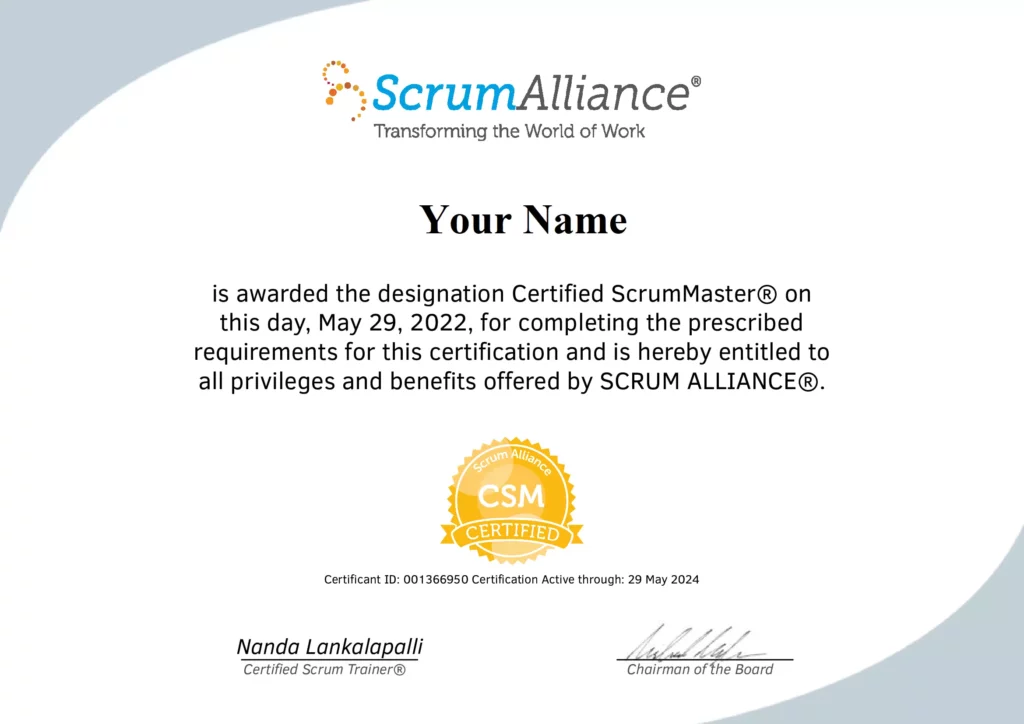
CSM Sample Certificate
Why Choose Us ?
- Activity Based Learning
- Get Opportunity to trained with India’s 1st CST who is eligible to Certify you on all six Modules of Scrum Alliance Courses, (CSM + A-CSM + CSP-SM + AISM + CAL-1)
- We believe in 100% Customer Satisfaction, If you don’t Like our Trainings, Talk to our team Immediately, 100% refund, No question asked.
- Career Guidence Support 24*7 – via chat, email and phone : Assistance with Scrum Alliance Exam Registration process, For knowledge sharing, Exam tips,Access to Local study groups.
Enroll Now & Get 5 FREE Video Courses
Our Students Say..
All the best Nanda!!